
Decatur County Court Records After a Jail Arrest
After a person is arrested in Decatur County and booked into the Decatur County Jail, the public record path usually splits into two tracks. The jail track is a custody record controlled by the Decatur County Sheriff's Office. The court track begins when the Decatur County Attorney files or pursues charges that become part of the Iowa District Court case. That court record can include the case number, charge text, charge level, scheduled hearings, bond activity, pleas, dismissals, amended counts, judgments, and final disposition.
The jail roster is still useful because it can show booking charges, a case number when one has been entered, bond fields, detainers, and a court tab. Those fields should be read as intake and custody information, not as the final court record. Use Decatur County jail inmate records for current custody and roster profile fields, and use Decatur County jail mugshots for booking-photo information. The formal case should be checked through Iowa Courts Online and, when documents or older files are needed, through the Decatur County Clerk of Court.
How to Find Decatur County Court Records After an Arrest
Iowa Courts Online is the main public docket system for Decatur County criminal cases. The public docket landing page describes the docket as an index of filings and proceedings in Iowa court cases. Public docket access is free and does not require a subscription, while advanced trial search tools require registration. Public documents themselves may need to be viewed at a courthouse public access terminal in the county where the case was filed.
The Iowa Courts Online landing page leads to the court-search options. The Iowa Courts Online search-selection page shows trial and appellate case search controls, payment search, registered advanced search, schedule search, and logon or registration options. Search results from the public trial court search are based on cases entered into ICIS through the end of the last business day, while selected case data is displayed from current clerk entries.
- Open Iowa Courts Online and choose the trial court case search option for a Decatur County criminal case.
- Search by defendant name, case number, or another field supported by the selected search tool.
- Open the case and compare the charge list with any booking charge shown on the jail roster.
- Check each charge for code, description, level, hearing history, bond activity, disposition, and current status.
The Iowa Courts Online selection screen captured in the research shows the controls used to reach public and registered searches.
Source: Iowa Courts Online search-selection page.
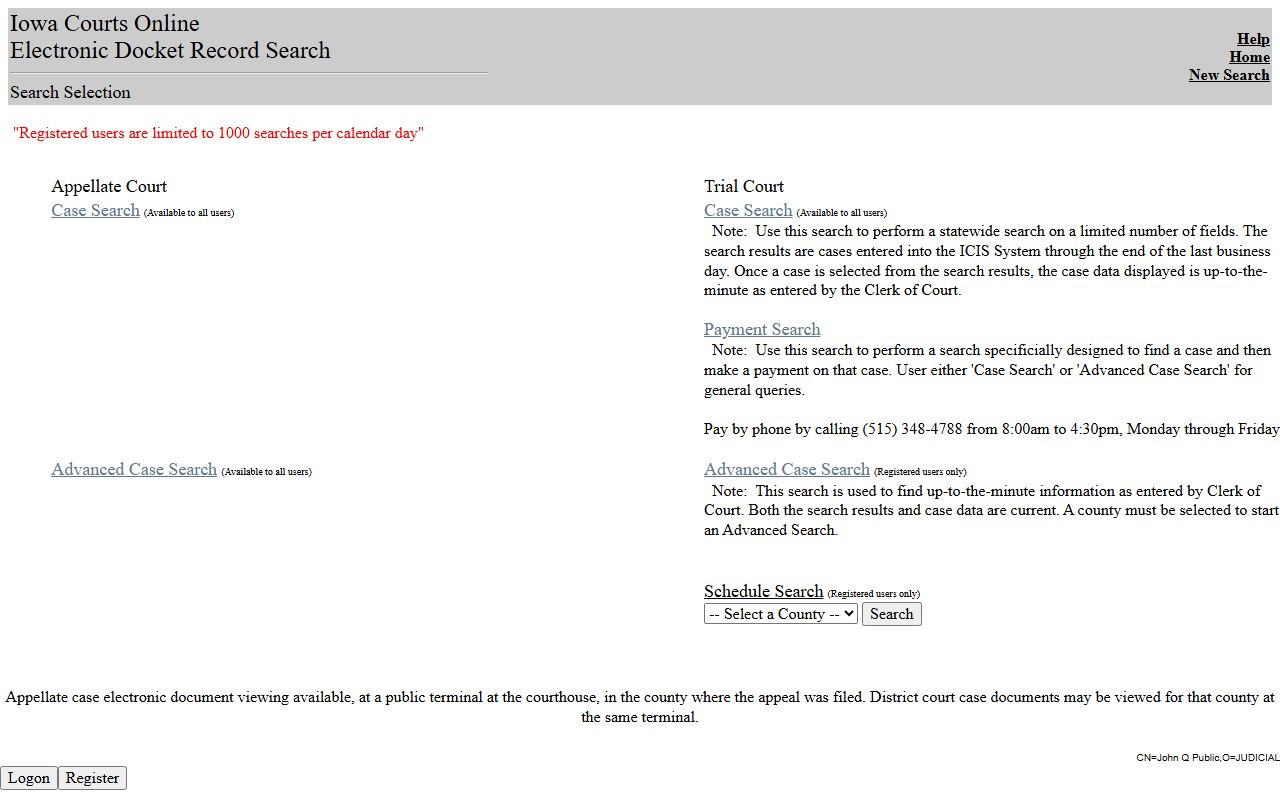
Those search options are the court-record side of a Decatur County arrest. They do not replace the BlueHorse jail roster for current custody, and the roster does not replace the court docket for formal filings.
| Control / Field | Type | Required | Notes |
|---|---|---|---|
| Trial Court - Case Search | Link | No login | Public case search for trial court cases, including criminal dockets. |
| Trial Court - Advanced Case Search | Link | Registered users only | Up-to-the-minute information with county selection when available to registered users. |
| Trial Court - Payment Search | Link | No login noted | Designed to find a case and make payment. |
| Schedule Search county dropdown | Dropdown | Yes for schedule search | Registered schedule search includes Decatur County value 05271. |
| Logon / Register | Buttons | For registered tools | Registered users are limited to 1000 searches per calendar day. |
How Charges Get Filed After an Arrest: Complaint, Trial Information, and Indictment
The arrest-to-court path in Decatur County usually starts with an arrest, transport to Decatur County Jail when local custody is required, booking, and a roster charge entry. The first appearance and release process is governed by Iowa Code sections 804.21, 804.22, and 811.2. After that, Decatur County Attorney Alan Wilson is the local prosecutor responsible for deciding how criminal charges are pursued in court.
Iowa criminal procedure can use a complaint, trial information, or indictment to move an accusation into the court record. The exact charging path depends on the offense and the procedural posture. A jail roster charge can be changed, replaced, reduced, or dismissed after the prosecutor reviews reports, witness information, criminal-history issues, bond concerns, and available evidence.
| Complaint | Trial Information | Indictment | |
|---|---|---|---|
| Filed By | Often an officer or prosecutor, depending on the case stage. | Prosecutor. | Grand jury. |
| Common For | Initial criminal accusations and many lower-level matters. | Many Iowa felony prosecutions after prosecutor review. | Serious charges or cases presented through grand-jury process. |
| Starts | A criminal case or early court proceeding. | The formal prosecutor-filed trial court case path. | A formal charge returned by the grand jury. |
| Why It Matters | May explain the first charge seen after arrest. | May replace the booking wording with the prosecutor's selected charges. | May differ from the original arrest description. |
Charge Status and What It Means
Charge status is the part of court records after an arrest that most often changes. The BlueHorse roster can display charge code, description, type, disposition, case number, OTN number, and offense date. Iowa Courts Online and the Decatur County Clerk should be used to verify the prosecutor-filed charges and final disposition because court charges can be amended, reduced, added, dropped, dismissed, or resolved by plea or trial.
| Status | What It Means |
|---|---|
| Pending | The charge remains open in court and has not reached a final disposition. |
| Amended / Reduced | The filed charge was changed, often to a different offense level, different wording, or a negotiated count. |
| Dismissed | The court record shows the charge was ended without a conviction on that count. |
| Disposed | The charge has reached an outcome, such as plea, judgment, dismissal, acquittal, or other court action. |
| Warrant / Failure to Appear Activity | The case may show warrant-related events if a missed court date or prior warrant led to custody. |
Bond and Release After an Arrest
Decatur County does not publish a county-specific bond payment instruction page in the sources reviewed. Local bond status should be checked on the Decatur County Jail roster's Bonds and Detainers tabs when a profile is available, by calling the jail at 641-446-4111, and through Iowa Courts Online or the Clerk of Court for court-set bond and hearing information.
Iowa's Uniform Bond Schedule applies only in defined circumstances before a person is seen by a judicial officer. The Iowa Judicial Branch schedule lists, for example, $20,000 for a Class C felony, $5,000 for a Class D felony, $2,000 for an aggravated misdemeanor, $1,000 for a serious misdemeanor, and $300 for a simple misdemeanor. After initial appearance, the judicial officer sets bond under Iowa Code section 811.2 and is not bound by the schedule. Some cases may not receive pre-appearance bond under the schedule, including listed forcible-felony, certain methamphetamine, stalking, domestic/protective-order, intimidation-with-dangerous-weapon, and felon-in-possession contexts.
Source: Iowa Judicial Branch uniform bond schedule.
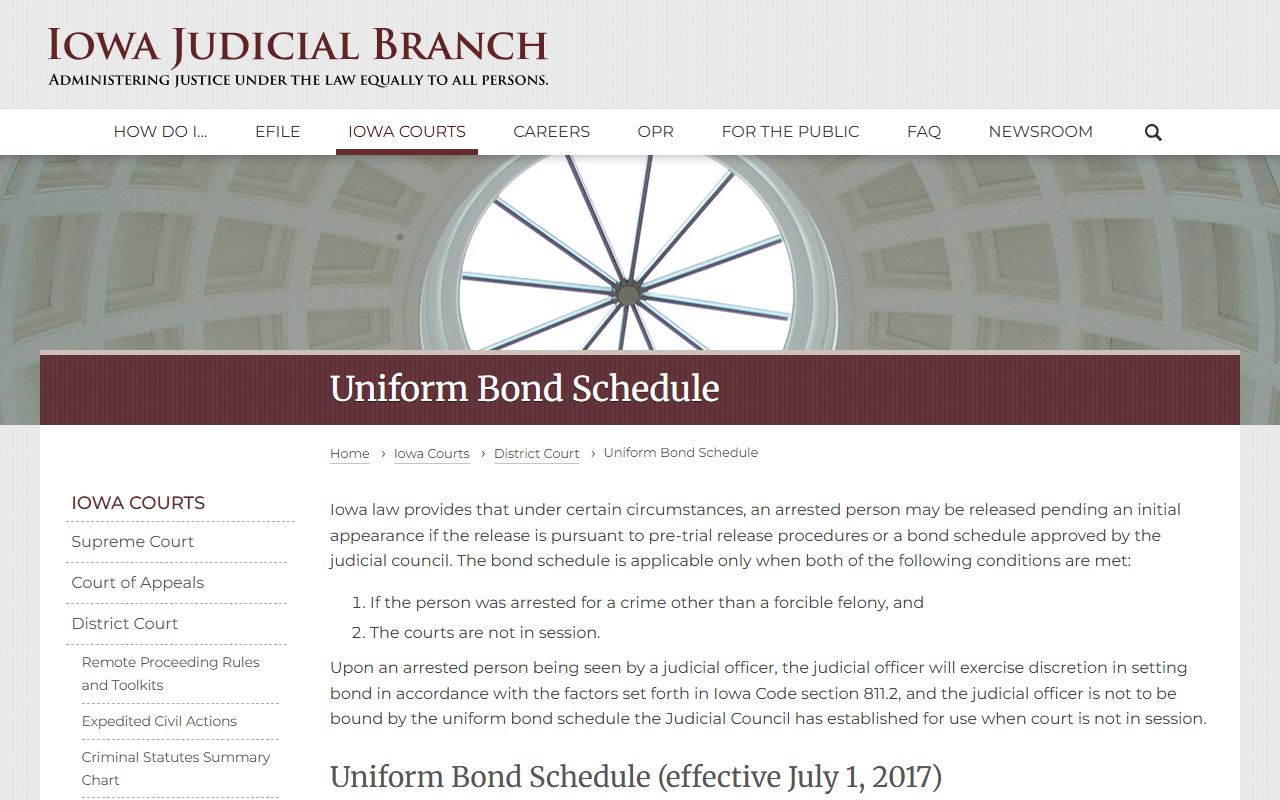
The schedule gives pre-appearance context, but Decatur County release status still depends on the roster bond entry, any hold or detainer, and the judge's order in the court case.
| Bond Type | How It Works |
|---|---|
| Cash Bond | Money is deposited as security for court appearance if the court or jail accepts that method for the case. |
| Surety Bond | A bonding company may be used when permitted, but Decatur County's official sources did not publish local surety procedures. |
| Personal Recognizance | The judicial officer may release a person on a promise to appear with court-set conditions. |
| No-Bond Hold | A person may remain in custody because of the charge type, a judicial order, probation/parole issue, or another agency hold. |
| Detainer or Hold | A separate agency or case may prevent release even when one Decatur County bond is posted. |
Warrants That Lead to an Arrest
No Decatur County active-warrant list, public warrant search, or most-wanted page was found on the official county site. A warrant can still lead to a Decatur County Jail booking, and a court docket can show warrant-related case activity when the warrant belongs to a public case. The sheriff/jail phone number, 641-446-4111, is the local routing point for custody and warrant-status questions. The sheriff's office is at 201 NE Idaho St. during business hours, and after-hours assistance is directed to the jail at 206 NE 2nd Street.
If a person is not on the current roster, that does not prove a warrant does not exist. The person may have bonded out, been transferred, never been booked locally, or have a warrant status that appears in court records rather than jail records. Iowa's criminal-justice agency systems are not the same as a public warrant-search website, so unofficial warrant sites should not be treated as controlling.
Charges vs. Convictions
An arrest charge is an accusation or custody entry. A conviction is a court outcome after a guilty plea, verdict, or other judgment that supports conviction. This distinction matters in Decatur County because the booking charge on the jail roster can be different from the prosecutor-filed charge, and both can be different from the final disposition in Iowa Courts Online.
| Charge | Conviction | |
|---|---|---|
| Stage | Accusation after arrest or prosecutor filing. | Final court outcome after plea, verdict, or judgment. |
| Proof Level | May begin with probable cause or charging review. | Requires proof beyond a reasonable doubt or an admitted plea. |
| Where It Appears | Jail roster charge tab and court docket, depending on timing. | Court docket, judgment records, and criminal-history records where public. |
| Can Change | Yes. Charges can be amended, reduced, dismissed, or replaced. | The conviction record can be corrected, appealed, or later affected by eligible expungement or confidentiality rules. |
Sealed vs. Expunged Arrest Records
Iowa's public-records law starts from access, but it also contains confidentiality limits. Iowa Code section 22.7 lists confidential-record exceptions, including limits for some law-enforcement investigative materials. Iowa Code section 901C.2 covers expungement for acquittals and dismissed criminal charges; expunged records become confidential under section 22.7 subject to limited access.
| Confidential / Sealed from Public View | Expunged Under Iowa Chapter 901C | |
|---|---|---|
| Visibility | Public access is restricted by statute, court rule, or order. | Eligible acquittal or dismissal records become confidential under Iowa law. |
| Law Enforcement | Limited official access may remain for authorized purposes. | Limited access can remain where the statute allows it. |
| Eligibility | Depends on the record type, juvenile status, investigation status, or court order. | Depends on the case result and the requirements of Iowa Code section 901C.2. |
| Where to Ask | Contact the Decatur County Clerk for court files and the Sheriff's Office for sheriff records. | Review the court case and consult counsel or the clerk for filing process questions. |
Background Check Considerations
Casual docket searches are not the same as legally compliant background screening. A person reviewing Decatur County court records after an arrest should separate current allegations from convictions, verify identity carefully, and remember that court records can be incomplete if a case is sealed, expunged, juvenile, or still being entered by the clerk. Employment, housing, credit, insurance, and tenant-screening decisions have separate legal requirements.
Important: This privately operated resource is not a consumer reporting agency and may not be used for any FCRA-covered decision.
Restricted Court Records After an Arrest in Decatur County
Some court and arrest records are not fully public. Juvenile matters, sealed charges, expunged dismissals or acquittals, protected victim information, and some investigative materials may be withheld or displayed only in limited form. Iowa Code section 22.2 gives public-record access unless another law limits it, and section 22.3 allows supervised copying with reasonable actual-cost fees. Section 22.7 is the key caution because it lists confidential categories that can affect law-enforcement and court-related records.
Decatur County Clerk of Court
Decatur County Courthouse
207 N. Main Street
Leon, IA 50144
641-219-4265
Monday-Friday, 8:00 a.m.-4:30 p.m.
Decatur County Attorney
Alan Wilson, County Attorney
207 N. Main Street
Leon, IA 50144
641-446-3773
Monday-Friday, 8:00 a.m.-4:30 p.m.